Your daughter asks about periods at the dinner table, and you hear yourself say “we’ll talk about it later.” You don’t.
Periods: The Complete Playbook, chapter 8 — including a dad’s edition.
Stay Connected · for parents of 8 to 14
When they’re little, they come to you because you’re their whole world. As they grow, you want them to keep coming to you because you’ve become a safe part of theirs.
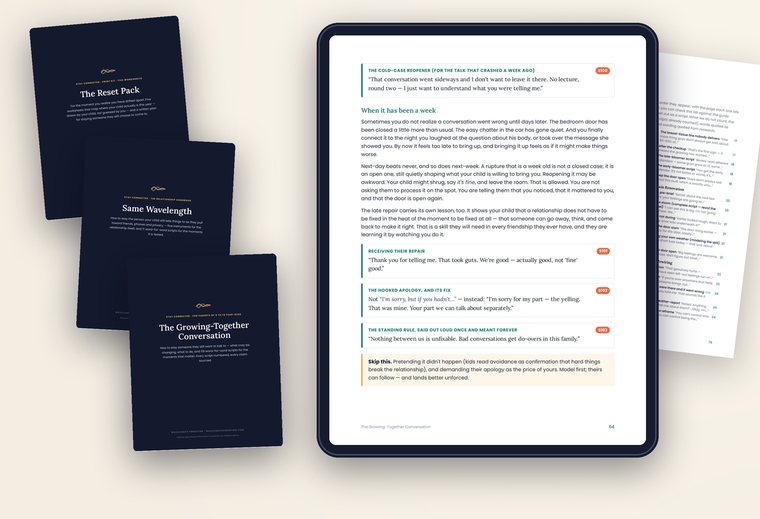
Two research-backed handbooks and a printable kit, with 134 word-for-word scripts for the moments when growing independence changes how you connect.
157 pages134 scriptsInstant downloadSources include AAP, NIMH & CDC
10% off through Sept 30: you pay $24.30.
They don’t stop needing you. They start needing you differently.
Maybe you’re already seeing it:
Stay Connected was built for these moments.

Sometimes the door closes in completely ordinary moments
Many of the things loving parents instinctively say can land as a message we never meant to send: maybe I shouldn’t bring this to Mom or Dad.
Said in a busy moment, and meant kindly. A child who spent a week working up to the question can hear not now, and probably not ever. Chapter 8 has the line that holds the door open when the timing really is wrong.
All understandable, and every one raises the price of telling you. Same Wavelength’s Honesty Tax chapter separates the disclosure from the situation, so you can thank them first and still hold any line you need.
It is the commonest plan. In the 2025 Mott Poll, 41% of parents said they would discuss puberty only when their child asks — and a child who can tell a subject is awkward hopes never to have to ask. Source: C.S. Mott Children’s Hospital National Poll on Children’s Health, April 2025.
Sound familiar?
Each of these has a chapter in Stay Connected, and every chapter ends with the words to say.
Your daughter asks about periods at the dinner table, and you hear yourself say “we’ll talk about it later.” You don’t.
Periods: The Complete Playbook, chapter 8 — including a dad’s edition.
Your son is ten. You know the talk about his changing body is due, and you’ve been waiting for the right moment for about a year.
The Body Timeline: Boys and Boys’ Changes: The Complete Playbook, chapters 4 and 9.
Your 9-year-old is already changing — body odor, a growth spurt, big moods — and you’re not sure whether that’s early, late or on time.
The Body Timeline chapters: the actual ages, for girls and for boys.
“Where do babies actually come from?” “What’s porn?” “Am I normal?”
The Awkward Questions, chapter 14: calm, word-for-word answers.
You snapped, lectured or laughed at the wrong moment, and now your child has gone quiet.
When a Conversation Goes Wrong, chapter 16: the repair, word for word.
The bedroom door clicks shut and stays shut until dinner. “How was school?” “Fine.” You find out about the fight with her best friend from another girl’s mother.
Same Wavelength, chapter 1: Am I Losing Them? — and chapter 4, The Honesty Tax.
He asks to walk to school alone, buy his own deodorant and keep his door shut — and each request gets decided on the spot, yes because you’re tired, no because you’re rattled.
The Reset Pack: the Control Transfer Map — what you hand over this year, area by area.
Three questions, every time. What may be happening? What should I do? What can I actually say?
That is the Wavelength method, and every chapter follows it: first what may be going on underneath the behavior, then what tends to help and what tends to backfire, then the words themselves — written out, numbered, and short enough to say in a car.
In the 2025 University of Michigan Mott Poll of 911 parents of 7 to 12 year-olds, 41% said they would discuss puberty only when their child asks, and only 31% felt their own parents had prepared them. Most of us were handed nothing to copy. You only ever need to be one conversation ahead.
Source: C.S. Mott Children’s Hospital National Poll on Children’s Health, “Approaching Puberty: Talking with Tweens about Body Changes,” April 2025. How we source every claim.
What’s inside Stay Connected
The core guide to what’s changing, the relationship handbook for what’s happening between you, and the worksheets for when you’ve drifted apart. Open any one to read a page from it.
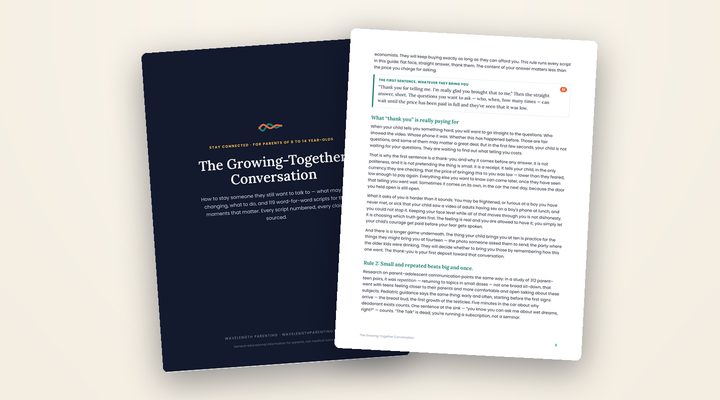
Handbook · 18 chapters · 91 pages
Eighteen chapters, in the order these years unfold.
Learn one formula and run it every time. The 3-step: (1) Affirm the ask — “good question” costs nothing and pays forever. (2) Short true answer — age-calibrated, no more than they asked for. (3) Invite the follow-up — “does that answer it, or do you want more?” Depth control belongs to the kid; calm belongs to you. And when you're genuinely stumped or shocked: buying time is legal. “Let me give you a real answer tonight” — then actually deliver tonight; the follow-through is the lesson.
“Great question. The short version: a sperm from a man and an egg from a woman join, and a baby grows in the uterus. Want the longer version now or later?”
“Yes. And also: everything you're describing is on the standard-equipment list. Ask me anything on it.”
From The Growing-Together Conversation · chapter 14, The Awkward Questions.
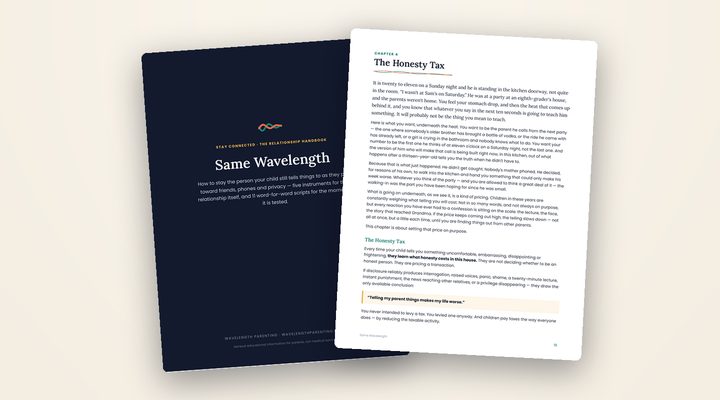
Handbook · 9 chapters · 40 pages
The relationship handbook: what is happening between the two of you while everything else changes.
Every time your child tells you something uncomfortable, embarrassing, disappointing or frightening, they learn what honesty costs in this house. They are not deciding whether to be an honest person. They are pricing a transaction.
This is not permissiveness. The fix is not that consequences disappear. The fix is that you stop fusing two entirely different events into one reaction. Event 1 — the disclosure. They came to you. Whatever else is true, that part is good and it is fragile. Event 2 — the situation. Separately, and usually later: what actually needs to happen?
Fuse them and you punish the telling. Separate them and you can hold any line you like while keeping the channel open.
Thank. Out loud, first. “I’m really glad you told me.” Even when — especially when — your stomach just dropped.
From Same Wavelength · chapter 4, The Honesty Tax. The chapter says plainly that the Honesty Tax is a Wavelength instrument — a practical way of thinking about your reactions — not a proven mechanism, and names the closest research it knows of.
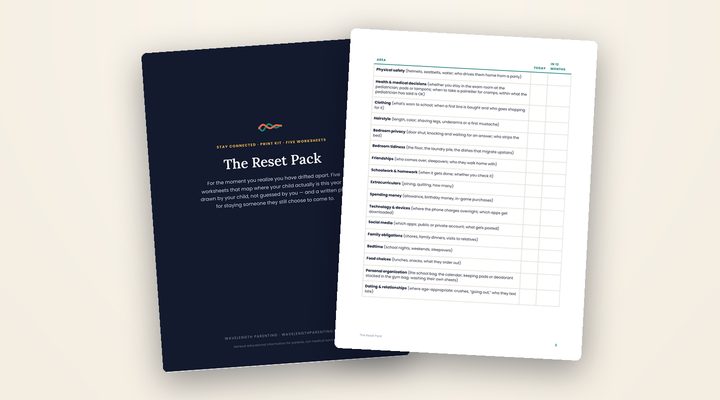
Printable kit · five worksheets
For the moment you realise you have drifted apart — a map of where your child actually is this year, drawn by your child, not guessed by you.
What you want is a fourteen-year-old who can handle real decisions and still wants to hear what you think about them. What is happening underneath the door and the deodorant is a child asking, in the only language available at twelve, whether his room and his body are starting to be his. If every answer is no, the requests don’t stop; they move somewhere you can’t see.
Independence isn’t a switch. It’s a transfer — area by area, at a pace set by demonstrated capability rather than by age alone.
Stage 1 · I decide → Stage 2 · We decide → Stage 3 · You decide, I advise → Stage 4 · You decide.
From The Reset Pack · The Control Transfer Map. The pack notes that the map is the Wavelength method — our practical approach to handing over control, not a research finding.
Inside it · chapter 2
The chapter about you, the parent.
“Heads up: I'm going to bring up some grown-up body stuff sometimes, and I might be a little awkward at it. That's my problem, not yours. I'd rather be awkward than quiet.”
“That's a real question and it deserves a real answer. Let me think about it today and I'll come back tonight.” — then actually come back tonight. The follow-through is the lesson.
From The Growing-Together Conversation · chapter 2, Get Yourself Ready First.
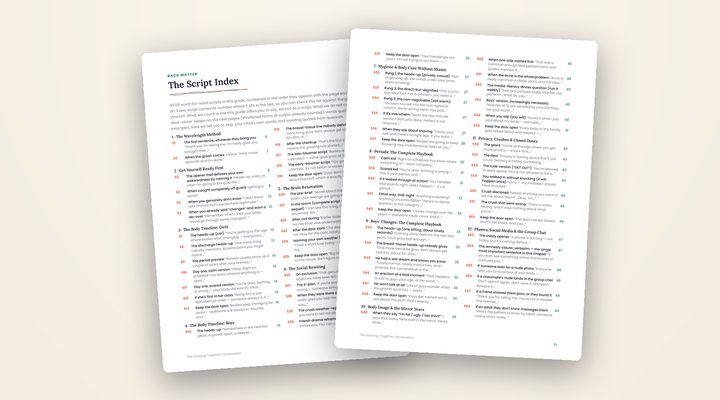
In every handbook
134 word-for-word scripts, each numbered and listed at the back of its handbook.
Free · included
7 conversations that are painful to miss, and the mistake hiding in each — practical words for talking about bodies, feelings, friends, and phones.
Read a page before you decide
You snapped, lectured, or laughed at the wrong moment, and now your child has gone quiet. This is the page for that, exactly as it reads in the guide. Every chapter ends the same way: the words to say, then the mistake to skip.
“I keep thinking about yesterday. You brought me something real and I turned it into a lecture. That’s on me. If you’re willing to try again, I’ll do the listening this time.”
Not “I’m sorry, but if you hadn’t…” — instead: “I’m sorry for my part — the yelling. That was mine. Your part we can talk about separately.”
“Nothing between us is unfixable. Bad conversations get do-overs in this family.”
Pretending it didn’t happen (kids read avoidance as confirmation that hard things break the relationship), and demanding their apology as the price of yours. Model first; theirs usually follows — and lands better unforced.
From The Growing-Together Conversation · chapter 16 of 18, When a Conversation Goes Wrong. The chapter’s sources are listed in full in the guide and at /sources.
Why parents can rely on it
American Academy of Pediatrics guidance, NIMH and CDC material and peer-reviewed research, cited in every handbook. Where the evidence is mixed, the text says so rather than picking a side — and where a tool is our own method rather than a research finding, it says that too.
So you can find the right words fast. Every script is numbered — S1 to S119 in The Growing-Together Conversation, S1 to S11 in Same Wavelength, S1 to S4 in The Reset Pack — and listed in the Script Index at the back of each.
The handbooks help you decide when something deserves a professional’s eyes, and send you to your pediatrician when it does. Crisis lines are printed where you will find them.
They judge the plan, never the parent: they name the common mistake, then hand you the sentence to use instead.
Our evidence standards are public at wavelengthparenting.com/sources. Wavelength Parenting is an independent publisher of research-backed handbooks and scripts for parents of 8 to 14 year-olds.
After you get Stay Connected
Read one chapter tonight. Have one short talk this week.
The Body Timeline chapters give the ages each change usually arrives, for girls and for boys, so you know what’s coming next.
Chapter 2 is about you, with the opener that defuses your own awkwardness by naming it: I’d rather be awkward than quiet.
Same Wavelength’s first chapter ends with three small things for tonight: knock and wait · let “fine” be fine · keep what they tell you between the two of you.
Reread the chapter for the stage you’re in, and redo the Reset Pack every six to twelve months. Every update reaches the same download link, free.
Stay Connected
The complete foundation for staying connected through the 8 to 14 years.
10% off the $27 price through 30 September. No code to enter — the discount is already applied at checkout.
The price you see here, $24.30, is the price you pay.
Covers ages 8 to 14 — less than $4 a year.
Get Stay Connected · $24.30$27Wavelength Parenting™
Digital only — nothing is mailed. Your receipt carries the download links, which never expire, and everything also reads in your Wavelength Library on any phone or laptop. 7-day money-back promise — refund policy.
Two ways in
Start here
$24.30$27
The complete solution to the central job: understanding this transition and knowing how to respond in ways that keep communication and connection open.
See what you get →Want everything
$97
Stay Connected plus the broader current collection — guidance ready for the situations that come next: two homes, a neurodivergent child, the phone that’s already here, grief, when to worry, the pediatrician visit — and three months of ENGAGE.
See Stay Connected: Complete →No wrong choice. Start with Stay Connected; if you want Complete later, you pay only the difference — $69.84. Email hello@wavelengthparenting.com and we’ll send it.
Not ready yet? Start with Still Their Person — 7 conversations that are painful to miss, and the mistake hiding in each. Free.
Educational information for parents and caregivers — not medical, psychological or therapeutic advice, and not a substitute for care from a professional who knows your child. Every claim traces to a named source; see our evidence standards.
Wavelength Parenting provides general educational information for parents and caregivers. It is not medical, psychological, or professional advice, and it is not a substitute for care from a pediatrician, therapist, or other qualified professional who knows your child. If your child may be in crisis, call or text 988 (988 Suicide & Crisis Lifeline) or contact emergency services. Wavelength Parenting™ · 2108 N St Ste N, Sacramento, CA 95816. We use Microsoft Clarity to see how visitors use this site; by using it you agree that we and Microsoft can collect and use that data (details). © 2026 Wavelength Parenting™. All rights reserved.