For parents of 8–14
Practice better judgment before the pressure is real—with 5 questions and 100 scripts for 20 situations they’ll face without you.

Instant accessOne paymentYours to keep
One day, they won’t ask you first. The question that used to come to you at dinner goes to the group chat, a search bar, an AI answer, or a friend.
You can’t be in every room. You can be in the question they ask themselves.
Maybe it has already started:
The first time they need the tool shouldn’t be the first time they’ve heard it.
A hard moment is a bad time to introduce a brand-new way of thinking. Practice the questions while the stakes are low — at dinner, in the car, on a walk — so the questions are already familiar when the stakes aren’t.
You don’t need to predict which situation comes first. You need to prepare the thinking before it does.
Get When You’re Not There · $27
Why the lecture misses
The lecture does the thinking for them. The part they needed to practice goes to you. When we supply the answer, the warning, the conclusion and the lesson, our child may hear exactly what we want them to know. But we also did the thinking. When You’re Not There works the other way: you ask the questions that make them practice the judgment they’ll eventually need without you.
That is how an American Academy of Pediatrics guide for parents of teens puts it. A 2025 AAP page on talking with teens adds: “When teens feel judged, they shut down. But when they feel heard, they often open up.” Source: HealthyChildren.org, American Academy of Pediatrics.
Experiments show that adolescents take more risks when peers are present or watching, while adults don’t. Source: Gardner and Steinberg, 2005; Chein and colleagues, 2011.
Teach less. Ask better questions.
When you ask, your child does the thinking. That one rule runs through all 20 moments.
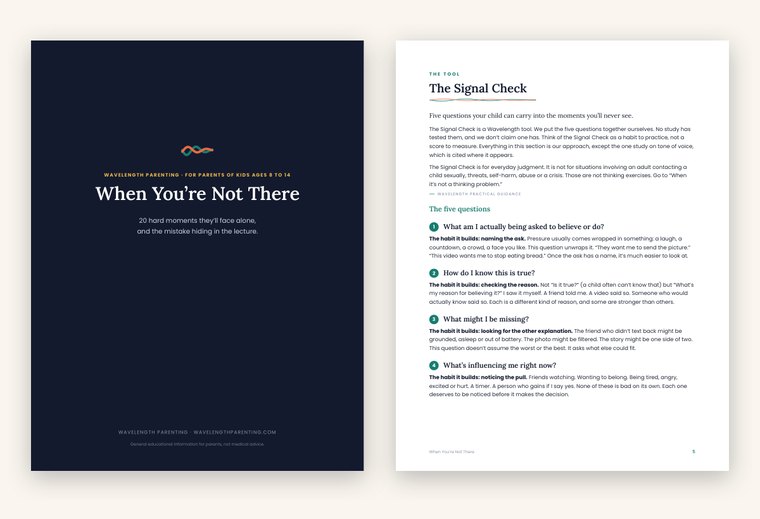
The Signal Check
For ages 8 to 9 there is a three-question version. For 10 to 11, two of the five in plainer words. For 12 to 14, two follow-ups: “Who gains if I believe this?” and “What would change my mind?”
Short enough to practice at dinner. Familiar enough to come back to later. The goal isn’t for your child to memorize a worksheet. It’s for these kinds of questions to become part of how they pause, notice what’s pulling at them, look for another explanation and make a choice.
The Signal Check is a Wavelength tool, built for home, with a version for every age from 8 to 14.
See how it works before you decide
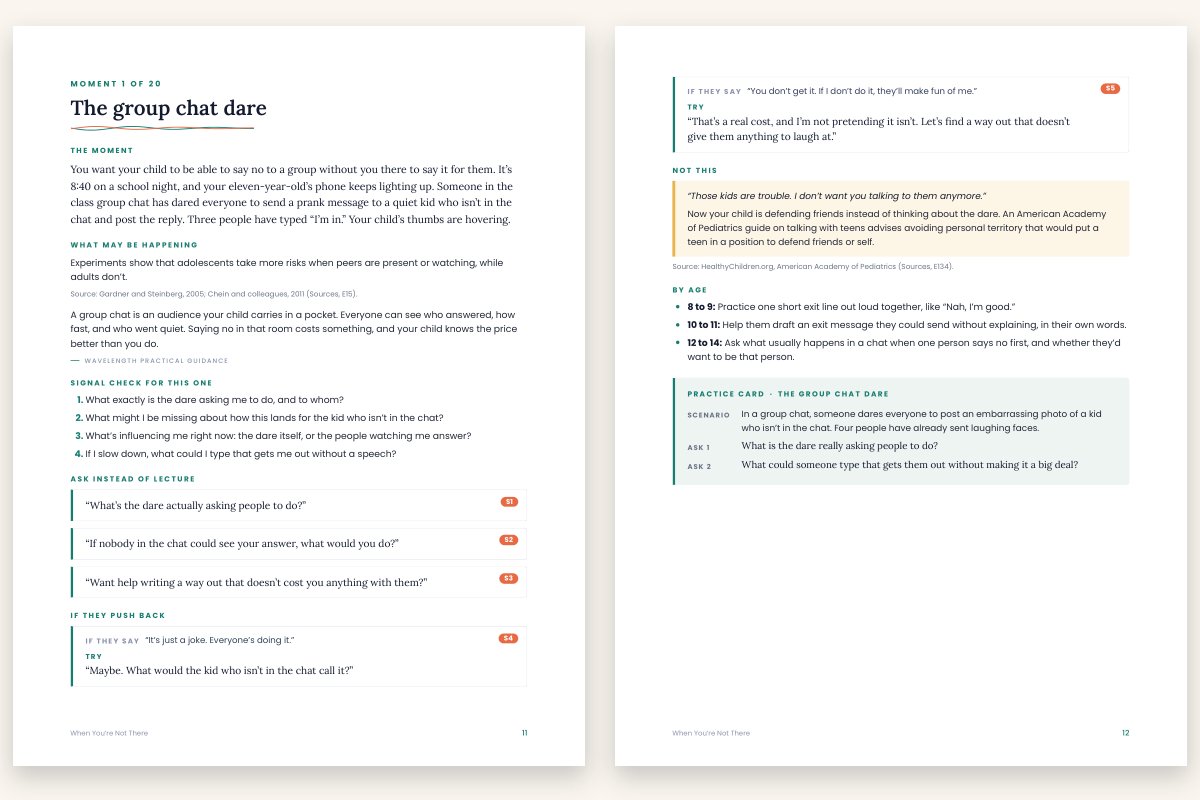
These lines are word for word from moment 1 of 20. Every moment follows the same shape, down to a practice card for a calm day.

It’s 8:40 on a school night, and your eleven-year-old’s phone keeps lighting up. Someone in the class group chat has dared everyone to send a prank message to a quiet kid who isn’t in the chat and post the reply. Three people have typed “I’m in.” Your child’s thumbs are hovering.
“What’s the dare actually asking people to do?”
“If nobody in the chat could see your answer, what would you do?”
“Want help writing a way out that doesn’t cost you anything with them?”
“Maybe. What would the kid who isn’t in the chat call it?”
“Those kids are trouble. I don’t want you talking to them anymore.” Now your child is defending friends instead of thinking about the dare. An American Academy of Pediatrics guide on talking with teens advises avoiding personal territory that would put a teen in a position to defend friends or self.
From When You’re Not There · moment 1 of 20. Every moment’s sources are listed in the book.
This is one moment. There are 19 more.
A rumor. A secret. Being left out. A viral challenge. A confident AI answer. A decision they want to make themselves.
You won’t know which one comes first. You can decide whether they’ve practiced the thinking before it does.
Get all 20 moments · $27100 scripts · 20 practice cards · instant access
What’s inside
Five questions, with versions for 8 to 9, 10 to 11 and 12 to 14, and how to introduce them without a lecture.
Each with the words to ask, what to say when they push back, what not to say, age adjustments and a five-minute practice card. 100 numbered scripts in all.
The five questions, four healthy sentences, the calm-moment rule and five “not this” lines, for the fridge or your phone.
Two pages on what to do and who to call when a situation should never be left to a child’s reasoning.
The 20 moments
Discerning, not suspicious
It’s a child who can decide what deserves trust, and explain why. The Signal Check isn’t meant to teach reflexive suspicion. It’s meant to create a pause between influence and decision.
In a 2025 classroom trial in France, one week after two 30-minute lessons, a new program helped only the seventh-graders tell real news from fake. Seven weeks later, eighth- and ninth-graders who had it were worse at it than before, mostly because they had started doubting real news too. The researchers call it a backfire effect. By seven weeks, the seventh-graders were no longer different from where they had started.
It was two short lessons in one country, compared with a standard lesson. What we take from it: aim for a child who can tell what deserves trust, and say why — not one who doubts everything. Source: Ghazi and colleagues, Computers in Human Behavior Reports, 2025.
Some moments aren’t thinking exercises
Some situations should never be left to a child’s reasoning alone: an adult contacting a child sexually, threats, self-harm, abuse, or any other crisis. When You’re Not There includes two pages on what to do in those moments and who to call, with contact details checked in September 2026.
Teach judgment. Not self-reliance at all costs.
Why parents can rely on it
Named sources. Clear boundaries. No invented authority.
American Academy of Pediatrics guidance, NIMH and CDC material, and peer-reviewed research, including a 2015 review of classroom experiments on teaching critical thinking and a three-year middle-school study of arguing ideas out. 24 source entries, listed in the back.
Where a line rests on a study or on AAP guidance, the source is named with it. Our own practical advice for home draws on that research and guidance, and it is marked “Wavelength practical guidance,” so you always know which is which.
General educational information for parents, not medical, psychological or legal advice. Crisis lines are printed where you will find them.
It judges the plan, never the parent: it names the common mistake, then hands you the question to ask instead.
Our evidence standards are public at wavelengthparenting.com/sources.
Be ready before the moment is real
$27 · one payment · yours to keep
The Signal Check and 20 moments, with the words to ask instead of the lecture. For parents of 8 to 14 year-olds.
Start tonight. Read the Signal Check (about ten minutes). Pick one moment this week. Practice it once on a calm day.
Get When You’re Not There · $27Instant digital access · 57 pages · read on any device or print
Pay by card, Apple Pay, Google Pay or PayPal
Wavelength Parenting™
Digital only — nothing is mailed. Your receipt carries the download link. Also included in Stay Connected: Complete.
You don’t have to “finish” it
It takes about ten minutes.
The one closest to your child’s life right now. You don’t need to go in order.
In the car, on a walk, at the sink. Ask its two questions, listen more than you talk, and stop at five minutes, even when it’s going well.
When the real version happens, reach for the “Ask instead of lecture” lines before anything else.
Before the next hard moment
You won’t be beside them for every one. And the moment itself is a difficult time to begin teaching a brand-new way of thinking.
Practice the questions while the stakes are low. Help them learn to pause, notice what’s pulling at them, look for what they may be missing, and make a choice on purpose.
Teach the questions now. Let them carry the questions later.
20 moments · 100 scripts · 57 pages · instant access
Start tonight. They’ll need the thinking later.
Educational information for parents and caregivers — not medical, psychological or therapeutic advice, and not a substitute for care from a professional who knows your child.
Wavelength Parenting provides general educational information for parents and caregivers. It is not medical, psychological, or professional advice, and it is not a substitute for care from a pediatrician, therapist, or other qualified professional who knows your child. If your child may be in crisis, call or text 988 (988 Suicide & Crisis Lifeline) or contact emergency services. Wavelength Parenting™ · 2108 N St Ste N, Sacramento, CA 95816. We use Microsoft Clarity to see how visitors use this site; by using it you agree that we and Microsoft can collect and use that data (details). © 2026 Wavelength Parenting™. All rights reserved.